Sustain Everyone

@SustainEveryone

How Parts of the Rockaways Maintain their Exclusivity (in context of NYC’s “City of Yes” Housing Law) — December 8, 2024

How Parts of the Rockaways Maintain their Exclusivity (in context of NYC’s “City of Yes” Housing Law)

History of the Development of the Neighborhoods in Rockaway, Queens, NYC.

This week the NYC City Council passed the “City of Yes” housing law, paving the way for an estimated 80,000 new homes to be built over the next 15 years to address the ongoing housing crisis. Despite this major step forward for our city, areas of NYC retain their exclusivity through zoning laws and historical legacy, like in the areas of Belle Harbor and Neponsit in Rockaway, Queens. Fierce opposition from residents and community groups (like the Belle Harbor Property Owners Association) in this area of Queens (and similar communities with historically restrictive zoning) resulted in a watered-down version of what housing advocates hoped would pass by the council. The version of the “City of Yes” law that passed aims to preserve the unique characteristics of communities like Belle Harbor and Neponsit, where zoning has only allowed single-family homes for decades. But how did this area become so exclusive in the first place? What happened throughout history to give these communities their “character”? To understand this, we have to look back to the communities’ founding and policies, both formal and informal, that shaped the development of the Rockaways.

Firstly, we must examine the impact of the federal government’s policies on neighborhood development through the Home Owners’ Loan Corporation’s (HOLC) color-coded maps of the 1930s (through a process known as redlining) to understand the disparity seen across the Rockaways. Redlining produced maps for every neighborhood in the country, dividing neighborhoods into 4 categories based on “perceived investment risk:”

  1. Green (Best): areas considered highly desirable (often white and affluent, wealthy, neighborhoods) 
  2. Blue (Still Desirable): areas considered good but significantly less affluent)
  3. Yellow (Definitely Declining): areas considered risky for investment, often with working-class residents and/or older infrastructure (often with a large immigrant population).
  4. Red (Hazardous): neighborhoods deemed the riskiest, often with significant populations of Black, immigrant, or low-income residents (outlined in red, where the term “redlining” comes from) and/or older infrastructure.

The green and blue designations were most desirable, and the yellow and red regions were designated too risky for investment. As a result, the people living in the yellow and red regions were systematically denied mortgages, businesses did not invest here, and it was used to justify ‘slum clearance’ projects (a hallmark of the Robert Moses era in the quest for ‘urban renewal’). These designations were racist & classist and based on the demographics of the people who lived in these areas at the time.

Here is how redlining played out on the Rockaway Penninsula by the HOLC in 1938:

To view an interactive map of redlined areas across NYC, click here.

As you can see on the map, large swaths of the Rockaways were deemed to be Grade C (Yellow, Definitely Declining). The main reasons for this were the significant Irish and Jewish populations and signs of Black migration into the area, as the HOLC explicitly considered these shifts as negative indicators for property values, using terms like “infiltration” to describe this shift. Other reasons for the low ratings were that Far Rockaway was the oldest community on the peninsula, containing both multi-family and single-family dwellings, so the housing infrastructure was viewed as lesser by evaluators compared to the more recently developed neighborhoods of mostly single-family homes. Some of Rockaway was also given Grade D or “hazardous” rating in the Hammels neighborhood, as well as parts of Far Rockaway, primarily because of its mix of Black, immigrant and Jewish people residing in this area. The impact of redlining is still felt today through economic decline, segregation, divestment, and stigmatization of these areas.

(Note: The community of Breezy Point is not included because it wasn’t formally developed as a cooperative until later in the 1960s. Much can be said about Breezy, but the focus for this post is on the other neighborhoods of Rockaway. To read more about how Breezy maintains its exclusivity, read A Gated Community in NYC Where Trump Flags Fly).

All of Rockaway was designated in Grade C (Yellow) “definitely declining” or Grade D (Red) “hazardous,” except for certain parts of Rockaway Park that were given Grabe B (Blue) or “still desirable,” starting from Beach 117th street to Beach 149th Street. These neighborhoods (Belle Harbor starting on Beach 126th Street, and Neponsit starting on Beach 142nd Street) were secluded from their inception; this section of Rockaway is not connected to the subway (which ends at Beach 116th Street) and was developed after the other neighborhoods on the peninsula. It was made up of mainly Irish and Jewish immigrant families, and the zoning laws from the beginning only allowed single-family homes.

HOLC evaluators explicitly favored neighborhoods that were racially homogeneous and white. Belle Harbor and Neponsit were overwhelmingly white and excluded Black and minority families through a combination of formal and informal practices, including restrictive covenants and community pressure. The absence of Black or other minority residents aligned with HOLC’s discriminatory standards. The houses in this area were also newer and made of higher-grade materials, making it more attractive to evaluators at the HOLC.
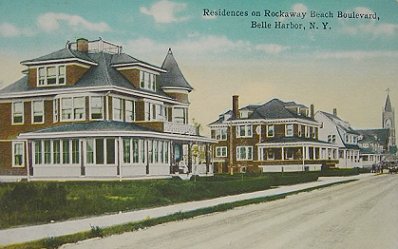
Belle Harbor, was founded in 1905 by real estate developer Frederick J. Lancaster. His vision was to create a high-end residential community along the Atlantic Ocean, marketed as a peaceful, escape from urban life. It was advertised as a “high-class residential district,” attracting affluent families from Manhattan and Brooklyn.

Neponsit was the last community to be developed, with advertisements like the one above explicitly stating “it’s a restricted community for refined people.”

Both Belle Harbor and Neponsit have a racial demographic make-up of 0% African American, with Belle Harbor having 87% white, 10% Hispanic and 3% Asian making up the rest, and Neponsit having 89% white, 8% Hispanic, 2% Two or More Races and 1% Asia (Source).

Given this history of how the Rockaways were developed, the impact of redlining, and the informal and formal practices to keep these sections for white residents only, I don’t think there is much of a defense for keeping the “character” of these communities intact via restrictive zoning laws that uphold these impacts today. The “City of Yes” spared these communities by allowing the parking requirements for new developments to stand as they are, as well as upholding the restrictive zoning that has led to the segregation we see here today.

I plan to unpack the “City of Yes” law more in future blog posts, so follow along for more if you found this post interesting!

If you want to learn more about the history and impact of redlining, read the book titled The Color of Law by Richard Rothstein.

NEPA Rollback & Environmental Justice — July 17, 2020

NEPA Rollback & Environmental Justice

When people say ‘let’s not dwell in the past,’ or ‘let’s not get too political,” I often cringe. I certainly see the value in not getting too caught up on some issue to the point where you become stuck, but I also see the harm it causes to not give voice to past injustices. By denying or refusing to acknowledge a people’s history, those in power (those who historically have been white people) create an alternative narrative that erases history and increase their own sense of worth, while at the same time further marginalizing people with less status and wealth (those who historically have been Black, Indigenous, and People of Color (BIPOC)).

We can only begin to uncover the oppressive structures and systems in place that perpetuate inequality and segregation in housing and education among black/white and rich/poor if we tell the stories of the past with honesty and clarity. Stories are a crucial way we reflect on and chronicle our lives, and they give meaning to our sense of place and place in time. Stories have been used to oppress, but they can also be used to liberate and heal.

Additionally, what policies and history contributes to the disparities we see across black and white communities in NYC and the USA in general? More specifically, why are our communities so unequal in terms of environmental burdens and other social determinants of health? I intent to explore these questions through my next series of posts more in detail. I believe part of it is because systematic racism exists at all levels of society (government agencies included), and the many cumulative effects of the policies enacted by these structures over time has lead to severe social inequities between white and BIPOC communities.

Recent news of President Trump’s plan to continue to roll back environmental regulation, specifically to make changed to NEPA (National Environmental Policy Act). I will briefly outline what NEPA is here, and what the proposed changes mean for social and environmental justice.

NEPA (National Environmental Policy Act) was signed into law under President Nixon in 1970, and it established a Council on Environmental Quality (CEQ) under the Office of the President, and required that all federal agencies’ projects to undergo an environmental assessments (EAs) and environmental impact statements (EIS), to weigh the costs and benefits of a proposed project to society, the economy, and the environment. NEPA also more broadly asserts that each person has a responsibility to enhance and preserve the environment for future generations, laying a framework for a more sustainable national environmental policy.

While I was an undergraduate student at SUNY Binghamton, I had the chance to take an Environmental Impact Statements class, where we learned how to prepare impact statements and all the components that are supposed to be considered before a federal project can proceed.

One of the main components of any EIS/EA is to consider the cumulative effects of the proposed actions. Rather than just considering the direct effects of the proposed project, it is equally or more important to consider the “combination of individually minor effects of multiple actions over time, or cumulative effects” (Source 1, see below).

From Council on Environmental Quality’s (CEQ) regulations for implementing the National Environmental Policy Act (NEPA), a cumulative impact is:

“the impact on the environment which results from the incremental impact of the action when added to other past, present, and reasonably foreseeable future actions regardless of what agency (Federal or non-federal) or person undertakes such other actions (40 CFR ~ 1508.7). (Source 1, see below)”

This part of NEPA, when applied appropriately, has been used to assess the cumulative impact of carbon emissions and its effect on climate change, and to address environmental justice issues that arise from the disproportionate implementation of harmful environmental projects in BIPOC communities, like highways and toxic waste facilities construction. (In a future post, I plan to dive more deeply into the history of this in NYC, specifically under NYC’s Parks Commissioner Robert Moses and the construction of the Henry Hudson Parkway and Mosholu Parkway during the 1930’s, which divided Van Cortlandt Park in the Bronx, home predominantly to BIPOC, creating 6 segmented parts of this once continuous greenspace) (Source 2, see below).

Development projects across the US have historically left out the input from BIPOC community members, leading to disparities that are cumulatively added to over time. We must protect NEPA, and even strengthen it in this unprecedented time of social inequity and ecological destruction. Rather than dilute consideration of environmental justice issues, these cumulative impacts should be top of mind and priority for those entrusted to run our federal agencies here in the USA.

Thank you for reading, and I hope you follow along as I discover the histories of NYC’s development that led to the segregation we experience in health, housing and education today.

@Hydroponics.NYC
@Matthew_Gerard_

Source 1:

President’s Council on Environmental Quality (CEQ). (n.d.). INTRODUCTION TO CUMULATIVE EFFECTS ANALYSIS. Retrieved from NEPA.gov: https://ceq.doe.gov/docs/ceq-publications/ccenepa/sec1.pdf

Source 2:
SEIWELL, E. (2019, February 19). Van Cortlandt Park Erases History . Retrieved from FordhamObserver.com: https://fordhamobserver.com/38076/features/van-cortlandt-park-erases-history/

Reframe: Sustain Everyone Blog — July 12, 2020

Reframe: Sustain Everyone Blog

As I reflect humbly on the current social landscape, it seems necessary to reframe this blog as a platform where I write about sustainability in terms of social and environmental justice, beginning to expose white supremacy in the past and in today’s systems and structures, in particular, to address the following questions:

1. What policies and history contribute to the disparities we see across communities in NYC, and in the US more generally (ex: redlining by the federal government via HOLC)?
2. How do/did people in power contribute to segregation in housing and education through overt and covert racist behavior today and in the past?
3. Why do disadvantaged communities face higher levels of environmental burdens than white communities?
4. How can we address racial segregation in housing and education on a local and national level?

I hope you follow along on this personal journey of growth and evolution, to look critically at oppressive structures and systems, and consider a path forward that acknowledges our history bias so that we continue to learn and build better systems with compassion and awareness.

@Matthew_Gerard_
@Hydroponics.NYC