Sustain Everyone

@SustainEveryone

How Parts of the Rockaways Maintain their Exclusivity (in context of NYC’s “City of Yes” Housing Law) — December 8, 2024

How Parts of the Rockaways Maintain their Exclusivity (in context of NYC’s “City of Yes” Housing Law)

History of the Development of the Neighborhoods in Rockaway, Queens, NYC.

This week the NYC City Council passed the “City of Yes” housing law, paving the way for an estimated 80,000 new homes to be built over the next 15 years to address the ongoing housing crisis. Despite this major step forward for our city, areas of NYC retain their exclusivity through zoning laws and historical legacy, like in the areas of Belle Harbor and Neponsit in Rockaway, Queens. Fierce opposition from residents and community groups (like the Belle Harbor Property Owners Association) in this area of Queens (and similar communities with historically restrictive zoning) resulted in a watered-down version of what housing advocates hoped would pass by the council. The version of the “City of Yes” law that passed aims to preserve the unique characteristics of communities like Belle Harbor and Neponsit, where zoning has only allowed single-family homes for decades. But how did this area become so exclusive in the first place? What happened throughout history to give these communities their “character”? To understand this, we have to look back to the communities’ founding and policies, both formal and informal, that shaped the development of the Rockaways.

Firstly, we must examine the impact of the federal government’s policies on neighborhood development through the Home Owners’ Loan Corporation’s (HOLC) color-coded maps of the 1930s (through a process known as redlining) to understand the disparity seen across the Rockaways. Redlining produced maps for every neighborhood in the country, dividing neighborhoods into 4 categories based on “perceived investment risk:”

  1. Green (Best): areas considered highly desirable (often white and affluent, wealthy, neighborhoods) 
  2. Blue (Still Desirable): areas considered good but significantly less affluent)
  3. Yellow (Definitely Declining): areas considered risky for investment, often with working-class residents and/or older infrastructure (often with a large immigrant population).
  4. Red (Hazardous): neighborhoods deemed the riskiest, often with significant populations of Black, immigrant, or low-income residents (outlined in red, where the term “redlining” comes from) and/or older infrastructure.

The green and blue designations were most desirable, and the yellow and red regions were designated too risky for investment. As a result, the people living in the yellow and red regions were systematically denied mortgages, businesses did not invest here, and it was used to justify ‘slum clearance’ projects (a hallmark of the Robert Moses era in the quest for ‘urban renewal’). These designations were racist & classist and based on the demographics of the people who lived in these areas at the time.

Here is how redlining played out on the Rockaway Penninsula by the HOLC in 1938:

To view an interactive map of redlined areas across NYC, click here.

As you can see on the map, large swaths of the Rockaways were deemed to be Grade C (Yellow, Definitely Declining). The main reasons for this were the significant Irish and Jewish populations and signs of Black migration into the area, as the HOLC explicitly considered these shifts as negative indicators for property values, using terms like “infiltration” to describe this shift. Other reasons for the low ratings were that Far Rockaway was the oldest community on the peninsula, containing both multi-family and single-family dwellings, so the housing infrastructure was viewed as lesser by evaluators compared to the more recently developed neighborhoods of mostly single-family homes. Some of Rockaway was also given Grade D or “hazardous” rating in the Hammels neighborhood, as well as parts of Far Rockaway, primarily because of its mix of Black, immigrant and Jewish people residing in this area. The impact of redlining is still felt today through economic decline, segregation, divestment, and stigmatization of these areas.

(Note: The community of Breezy Point is not included because it wasn’t formally developed as a cooperative until later in the 1960s. Much can be said about Breezy, but the focus for this post is on the other neighborhoods of Rockaway. To read more about how Breezy maintains its exclusivity, read A Gated Community in NYC Where Trump Flags Fly).

All of Rockaway was designated in Grade C (Yellow) “definitely declining” or Grade D (Red) “hazardous,” except for certain parts of Rockaway Park that were given Grabe B (Blue) or “still desirable,” starting from Beach 117th street to Beach 149th Street. These neighborhoods (Belle Harbor starting on Beach 126th Street, and Neponsit starting on Beach 142nd Street) were secluded from their inception; this section of Rockaway is not connected to the subway (which ends at Beach 116th Street) and was developed after the other neighborhoods on the peninsula. It was made up of mainly Irish and Jewish immigrant families, and the zoning laws from the beginning only allowed single-family homes.

HOLC evaluators explicitly favored neighborhoods that were racially homogeneous and white. Belle Harbor and Neponsit were overwhelmingly white and excluded Black and minority families through a combination of formal and informal practices, including restrictive covenants and community pressure. The absence of Black or other minority residents aligned with HOLC’s discriminatory standards. The houses in this area were also newer and made of higher-grade materials, making it more attractive to evaluators at the HOLC.
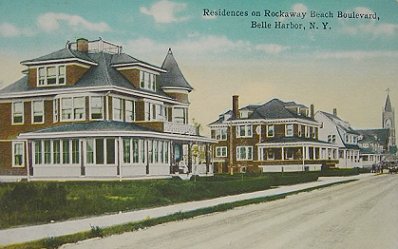
Belle Harbor, was founded in 1905 by real estate developer Frederick J. Lancaster. His vision was to create a high-end residential community along the Atlantic Ocean, marketed as a peaceful, escape from urban life. It was advertised as a “high-class residential district,” attracting affluent families from Manhattan and Brooklyn.

Neponsit was the last community to be developed, with advertisements like the one above explicitly stating “it’s a restricted community for refined people.”

Both Belle Harbor and Neponsit have a racial demographic make-up of 0% African American, with Belle Harbor having 87% white, 10% Hispanic and 3% Asian making up the rest, and Neponsit having 89% white, 8% Hispanic, 2% Two or More Races and 1% Asia (Source).

Given this history of how the Rockaways were developed, the impact of redlining, and the informal and formal practices to keep these sections for white residents only, I don’t think there is much of a defense for keeping the “character” of these communities intact via restrictive zoning laws that uphold these impacts today. The “City of Yes” spared these communities by allowing the parking requirements for new developments to stand as they are, as well as upholding the restrictive zoning that has led to the segregation we see here today.

I plan to unpack the “City of Yes” law more in future blog posts, so follow along for more if you found this post interesting!

If you want to learn more about the history and impact of redlining, read the book titled The Color of Law by Richard Rothstein.

St. Edward’s Magazine Story — June 27, 2023
Turn Any Bottle into a Hydroponic Wick System — November 4, 2022

Turn Any Bottle into a Hydroponic Wick System

Made some updates to the directions:

Matthew Horgan, NYC's avatarSustain Everyone

Materials:

Process:

  1. Create a bottom and top chamber out of your bottle.
    Cut the top of the bottle off about 3 inches below where the curve starts.
  2. Make a hole in the cap. Use the tip of a pen or hole puncher (or drill if using a soda bottle or other thick plastic cap) to make a hole in the bottle cap. You can punch a hole in the plastic near the mouth of the bottle if this is easier.
  3. Thread a wick through the hole in the bottle cap and tie a knot. Be sure to hold the upper end of the wick upright and fill the coco coir around the wick to ensure moisture at top of the coco…

View original post 447 more words

Build A Deep Water Culture (DWC) Hydroponic Garden in Less than an Hour — October 23, 2022

Build A Deep Water Culture (DWC) Hydroponic Garden in Less than an Hour

Ever have the urge to grow something green? Since most of us live in cities, access to space to grow plants is practically non-existent and soils are often contaminated with heavy metals and other industrial pollutants. Despite these conditions, people are using creative hydroponic growing techniques that do not require soil or much space to grow nutrient-dense food in their homes.

Hydroponic systems are unique in that they do not use soil to grow plants. Instead, plants use nutrient-rich water (nutrient solution) and growing media (like coco coir, made from coconut husks) for nutrition & root support. 

Recently, I built a container deep water culture hydroponic system by re-purposing an old storage container (10 gallons). In deep water culture (DWC) systems, plants sit directly in nutrient-rich water, and an air pump & air stone keeps the water from getting stagnant by blowing bubbles into the water.

It was super easy, and I’ve outlined the steps here so you can construct your own DWC hydroponic herb garden for your home today!

Step 1: Gather your materials (see links at end of the post):

-10-gallon storage tote (or bus box with lid),
-Drill,
-2″ hole saw drill attachment,
-Net pots (2″),
-Coco coir plugs,
-Dry nutrients part A and B for lettuce (also good for herbs),
-Digital EC meter & pH meter,
-Measuring spoon (1 teaspoon),
-Air pump,
-Air stone,
-Herb & lettuce seeds

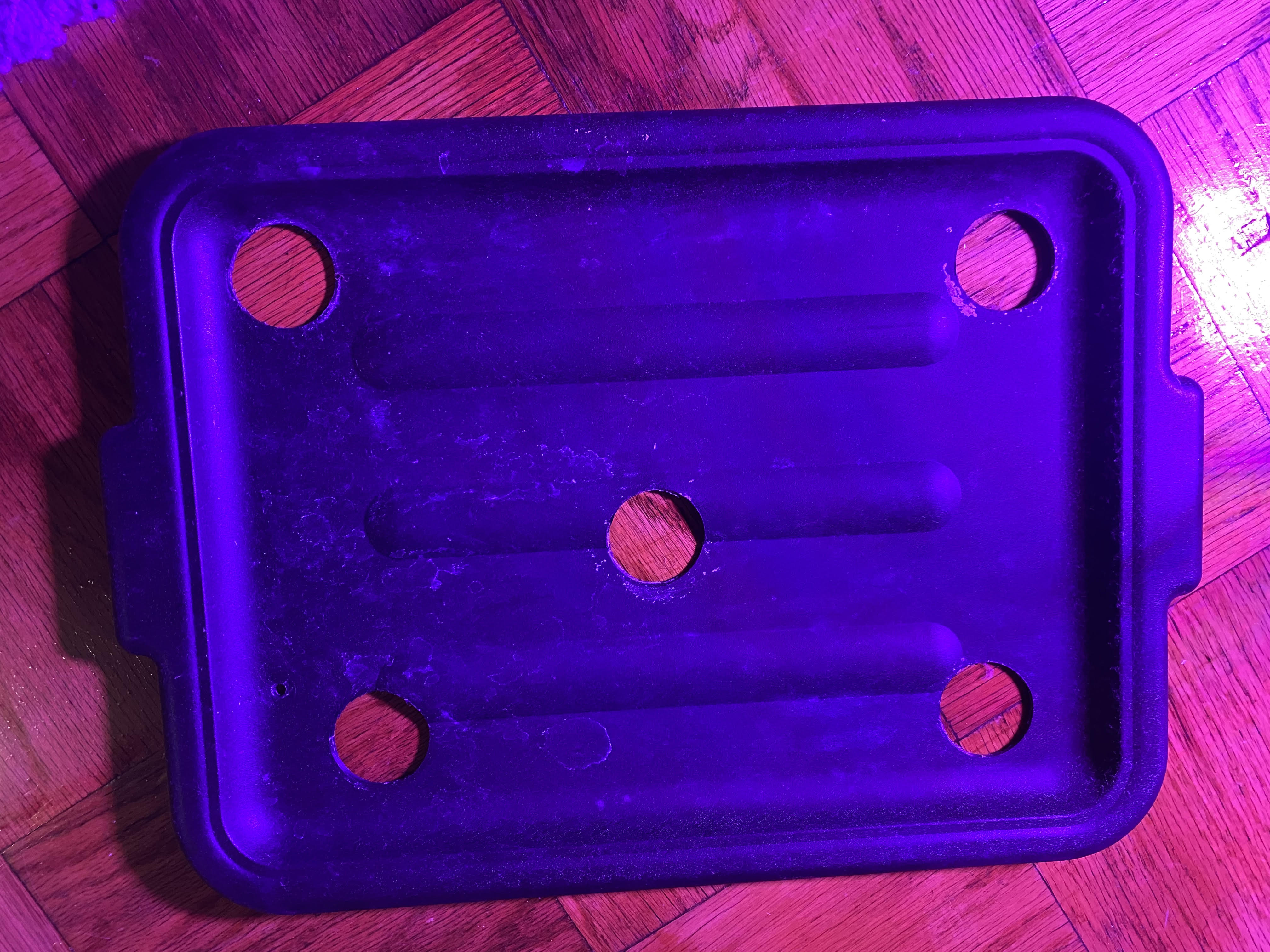
Step 2: Drill holes into the lid of your storage tote.

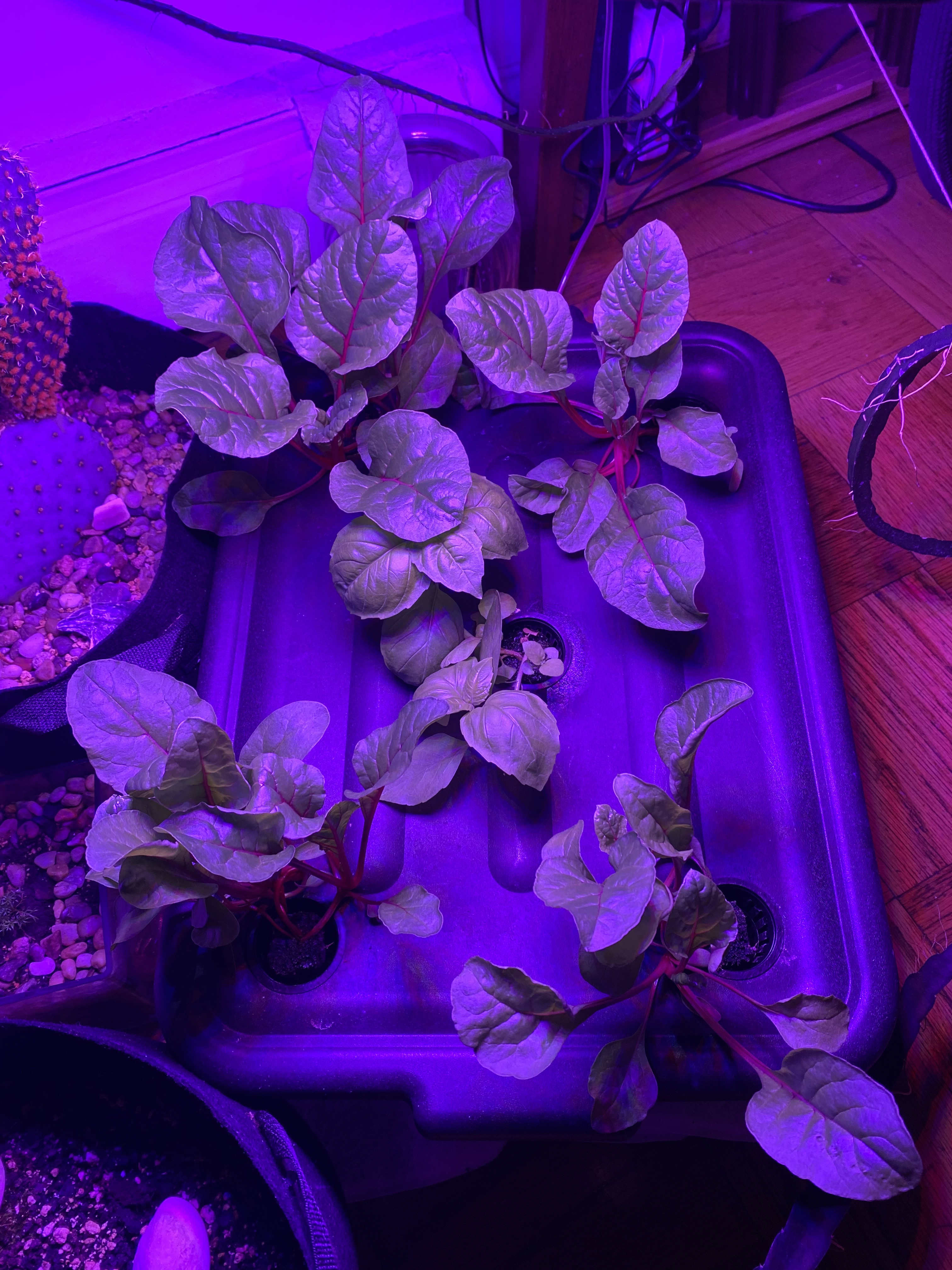
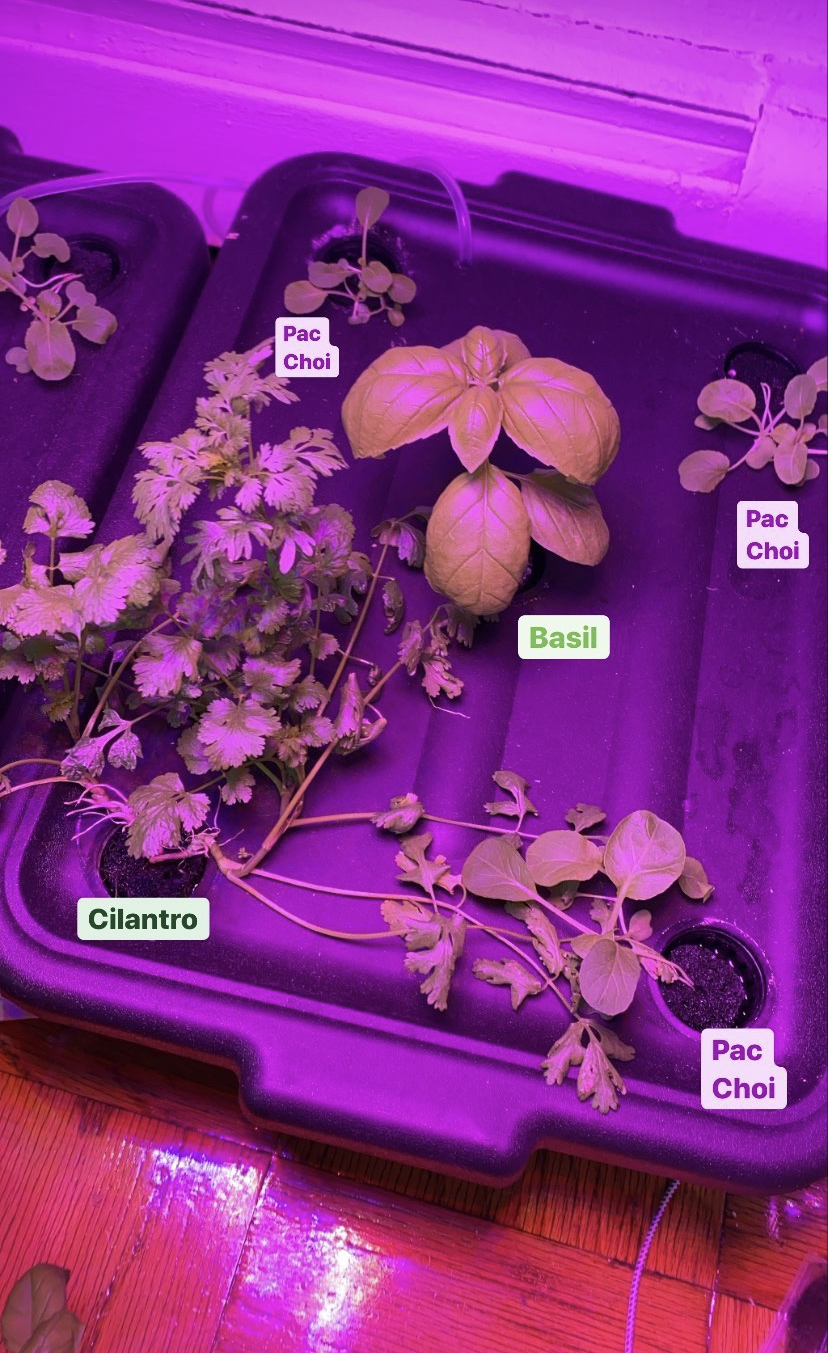
5-8 plant sites fit well per 10-gallon container, this spacing will allow your plants to grow to full maturity. Lettuce takes 4-6 weeks to harvest, and cooking greens & herbs take 8-12 weeks. 

unnamed @Hydroponics.NYC

Step 3: Fill the container nearly to the top with tap water & add dry nutrients.

A simple method for making nutrient solution is to take a quart-sized container and fill it nearly to the top with tap water (you can use the water that is already in your tote.) Then, mix a teaspoon of part A and a teaspoon of part B of the dry nutrients until all nutrients dissolve in the water. Add nutrient solution to your 10-gallon container and fill it with tap water until it is nearly full. Measure the electrical conductivity (EC) using the handheld digital reader.

You want the EC to measure 900-1300 ppm (1.5-2.5) to grow most herbs and lettuce, and you can add 1/4 of a teaspoon of each part A & B  and then measure the EC again, repeat as necessary until you reach the desired EC level. After each harvest, check your EC and add nutrients & water when necessary to maintain the 900-1300 ppm (1.5-2.5) range.

*For cucumbers/peppers/tomatoes, desired EC range: 1500-2500 ppm (2.5-3.5).

Step 4: Installing the air pump and air stone

The air pump attaches to the air stone via a small plastic tube (usually provided). Place the air stone in the nutrient solution and the air pump at a higher elevation than the level of the water in your deep water culture system (to prevent a siphoning of water out of your system).

IMG-8632
IMG-8633

@matthew_gerard_

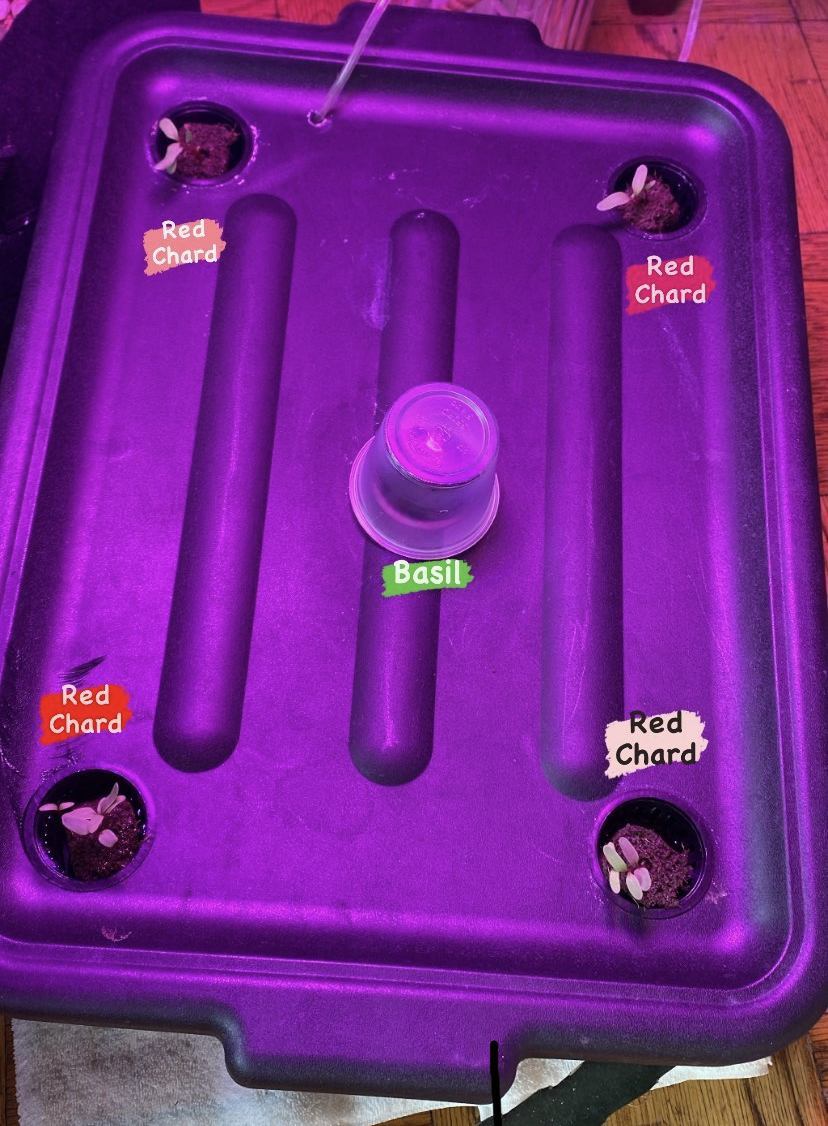
Step 5: Insert the net pots and coco coir cubes into the holes you cut for each plant site.

You want the bottom of the net pots to be submerged in the nutrient solution, then add a coco coir plug to each plant site.

Step 6: Plant your seeds & place them under a light source.
Now you are ready to plant your seeds in each plug (Ideally, 1 lettuce seed per site or 3 herb seeds per site)

*Be sure to place your system under sunlight or an artificial light source to ensure your plants can photosynthesize!

IMG-8627

@matthew_gerard_

Suggestions:
-If it’s summer, consider placing your DWC hydroponic garden outside under direct sunlight, or if one of your windows gets a ton of sun, place it there.

-If you have space under a coffee table, consider using this lamp or installing these lights on the bottom of the table and placing your DWC hydroponic garden under there.

Links to Materials I used:

IG accounts:
@Hydroponics.NYC
@Matthew_Gerard_

IMG-8634
NEPA Rollback & Environmental Justice — July 17, 2020

NEPA Rollback & Environmental Justice

When people say ‘let’s not dwell in the past,’ or ‘let’s not get too political,” I often cringe. I certainly see the value in not getting too caught up on some issue to the point where you become stuck, but I also see the harm it causes to not give voice to past injustices. By denying or refusing to acknowledge a people’s history, those in power (those who historically have been white people) create an alternative narrative that erases history and increase their own sense of worth, while at the same time further marginalizing people with less status and wealth (those who historically have been Black, Indigenous, and People of Color (BIPOC)).

We can only begin to uncover the oppressive structures and systems in place that perpetuate inequality and segregation in housing and education among black/white and rich/poor if we tell the stories of the past with honesty and clarity. Stories are a crucial way we reflect on and chronicle our lives, and they give meaning to our sense of place and place in time. Stories have been used to oppress, but they can also be used to liberate and heal.

Additionally, what policies and history contributes to the disparities we see across black and white communities in NYC and the USA in general? More specifically, why are our communities so unequal in terms of environmental burdens and other social determinants of health? I intent to explore these questions through my next series of posts more in detail. I believe part of it is because systematic racism exists at all levels of society (government agencies included), and the many cumulative effects of the policies enacted by these structures over time has lead to severe social inequities between white and BIPOC communities.

Recent news of President Trump’s plan to continue to roll back environmental regulation, specifically to make changed to NEPA (National Environmental Policy Act). I will briefly outline what NEPA is here, and what the proposed changes mean for social and environmental justice.

NEPA (National Environmental Policy Act) was signed into law under President Nixon in 1970, and it established a Council on Environmental Quality (CEQ) under the Office of the President, and required that all federal agencies’ projects to undergo an environmental assessments (EAs) and environmental impact statements (EIS), to weigh the costs and benefits of a proposed project to society, the economy, and the environment. NEPA also more broadly asserts that each person has a responsibility to enhance and preserve the environment for future generations, laying a framework for a more sustainable national environmental policy.

While I was an undergraduate student at SUNY Binghamton, I had the chance to take an Environmental Impact Statements class, where we learned how to prepare impact statements and all the components that are supposed to be considered before a federal project can proceed.

One of the main components of any EIS/EA is to consider the cumulative effects of the proposed actions. Rather than just considering the direct effects of the proposed project, it is equally or more important to consider the “combination of individually minor effects of multiple actions over time, or cumulative effects” (Source 1, see below).

From Council on Environmental Quality’s (CEQ) regulations for implementing the National Environmental Policy Act (NEPA), a cumulative impact is:

“the impact on the environment which results from the incremental impact of the action when added to other past, present, and reasonably foreseeable future actions regardless of what agency (Federal or non-federal) or person undertakes such other actions (40 CFR ~ 1508.7). (Source 1, see below)”

This part of NEPA, when applied appropriately, has been used to assess the cumulative impact of carbon emissions and its effect on climate change, and to address environmental justice issues that arise from the disproportionate implementation of harmful environmental projects in BIPOC communities, like highways and toxic waste facilities construction. (In a future post, I plan to dive more deeply into the history of this in NYC, specifically under NYC’s Parks Commissioner Robert Moses and the construction of the Henry Hudson Parkway and Mosholu Parkway during the 1930’s, which divided Van Cortlandt Park in the Bronx, home predominantly to BIPOC, creating 6 segmented parts of this once continuous greenspace) (Source 2, see below).

Development projects across the US have historically left out the input from BIPOC community members, leading to disparities that are cumulatively added to over time. We must protect NEPA, and even strengthen it in this unprecedented time of social inequity and ecological destruction. Rather than dilute consideration of environmental justice issues, these cumulative impacts should be top of mind and priority for those entrusted to run our federal agencies here in the USA.

Thank you for reading, and I hope you follow along as I discover the histories of NYC’s development that led to the segregation we experience in health, housing and education today.

@Hydroponics.NYC
@Matthew_Gerard_

Source 1:

President’s Council on Environmental Quality (CEQ). (n.d.). INTRODUCTION TO CUMULATIVE EFFECTS ANALYSIS. Retrieved from NEPA.gov: https://ceq.doe.gov/docs/ceq-publications/ccenepa/sec1.pdf

Source 2:
SEIWELL, E. (2019, February 19). Van Cortlandt Park Erases History . Retrieved from FordhamObserver.com: https://fordhamobserver.com/38076/features/van-cortlandt-park-erases-history/

Reframe: Sustain Everyone Blog — July 12, 2020

Reframe: Sustain Everyone Blog

As I reflect humbly on the current social landscape, it seems necessary to reframe this blog as a platform where I write about sustainability in terms of social and environmental justice, beginning to expose white supremacy in the past and in today’s systems and structures, in particular, to address the following questions:

1. What policies and history contribute to the disparities we see across communities in NYC, and in the US more generally (ex: redlining by the federal government via HOLC)?
2. How do/did people in power contribute to segregation in housing and education through overt and covert racist behavior today and in the past?
3. Why do disadvantaged communities face higher levels of environmental burdens than white communities?
4. How can we address racial segregation in housing and education on a local and national level?

I hope you follow along on this personal journey of growth and evolution, to look critically at oppressive structures and systems, and consider a path forward that acknowledges our history bias so that we continue to learn and build better systems with compassion and awareness.

@Matthew_Gerard_
@Hydroponics.NYC

Climate Science Navigator: Why? — January 26, 2020

Climate Science Navigator: Why?

Illustration by Matthew Laznicka (http://inthesetimes.com/)

Climate skepticism is the denial of the overwhelming scientific consensus that human activity is causing a rise in the concentration of greenhouse gases in the atmosphere that is driving the global climate crisis. With so much misinformation intentionally spread by multinational corporations and politicians whose interests lie in the continued destruction of the planet, people must be able to navigate the up-to-date data on climate science to make informed decisions. This climate science navigator will be a series of posts that can be used to learn and share the data that global, national, and local agencies gathered and reported to the public over the past 10 years on the unfolding climate crisis.

Look out for upcoming posts titled:

Climate Science Navigator: Global Reports on Climate Change

Climate Science Navigator: National Reports on Climate Change

Climate Science Navigator: Local Reports on Climate Change

Instagram: @Hydroponics.NYC
& @Matthew_Gerard_

Turn Any Bottle into a Hydroponic Wick System — August 18, 2019

Turn Any Bottle into a Hydroponic Wick System

Materials:

Process:

  1. Create a bottom and top chamber out of your bottle.
    Cut the top of the bottle off about 3 inches below where the curve starts.
  2. Make a hole in the cap. Use the tip of a pen or hole puncher (or drill if using a soda bottle or other thick plastic cap) to make a hole in the bottle cap. You can punch a hole in the plastic near the mouth of the bottle if this is easier.
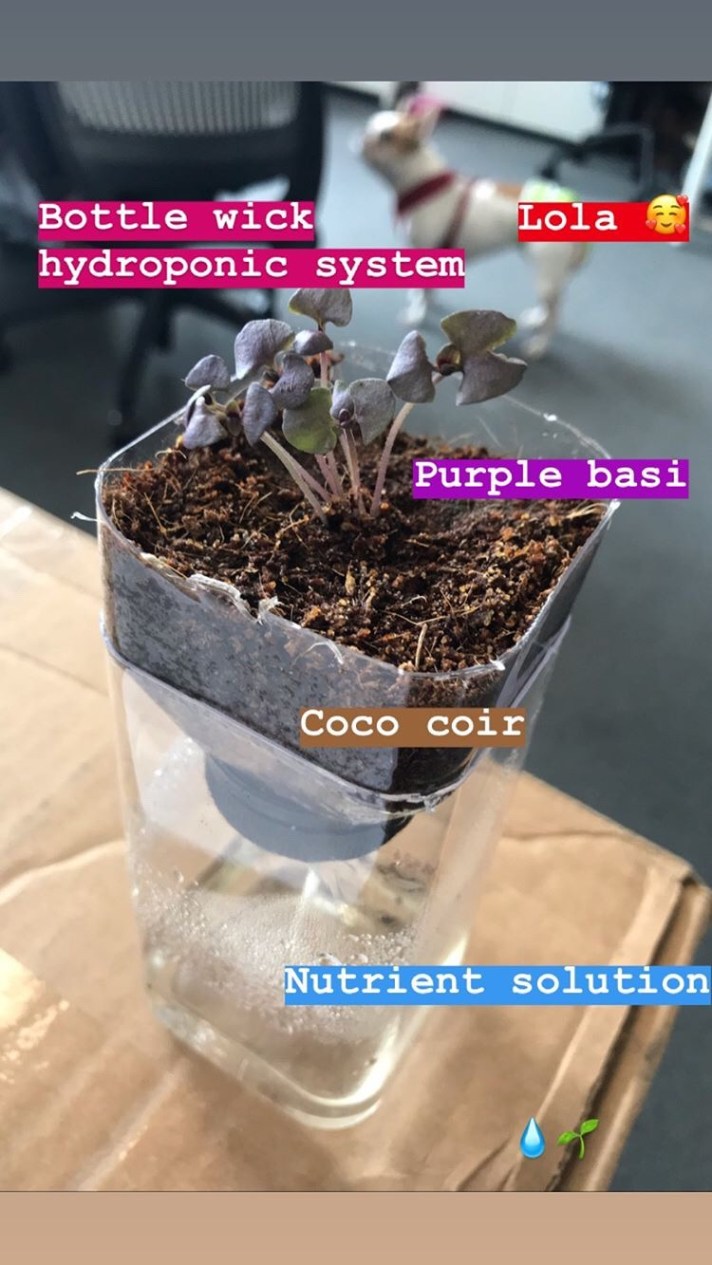
  3. Thread a wick through the hole in the bottle cap and tie a knot. Be sure to hold the upper end of the wick upright and fill the coco coir around the wick to ensure moisture at top of the coco coir. Use a pen to assist in threading the wick through the bottle cap, cut the wick long enough on both sides of the cap to reach the bottom of the bottom chamber and near the top of the coco coir in the top chamber.
  4. Attach the bottom and top chambers.  Turn the top chamber upside down to allow the wick to sit in the bottom chamber and staple the top part to the bottom part in one spot. Be sure not to staple all sides to allow you to add nutrient solution when necessary.
  5. Fill the bottom chamber with nutrient solution.
    • *To mix nutrient solution:
      • Using a 1/32 Teaspoon, add dry nutrients:
        • For Basil & Lettuce: Add 2-3 scoops of dry nutrients (Ideal EC = 700 to 1200)
        • For edible flowers, mint, endive, and mustard greens: add 3-4 scoops of dry nutrients (Ideal EC = 1400-1700) 
        • Ideal pH of all nutrient solution = 5.5 to 6.5
        • You can test the nutrient level by using a digital meter.
        • When your water level drops significantly, add tap water to keep the wick underwater in the bottom chamber. You do not need to any more nutrients for the life of this plant, just fresh tap water to maintain the water level (keeping the wick submerged).
  6. Fill the top chamber with coco coir and plant your seeds.
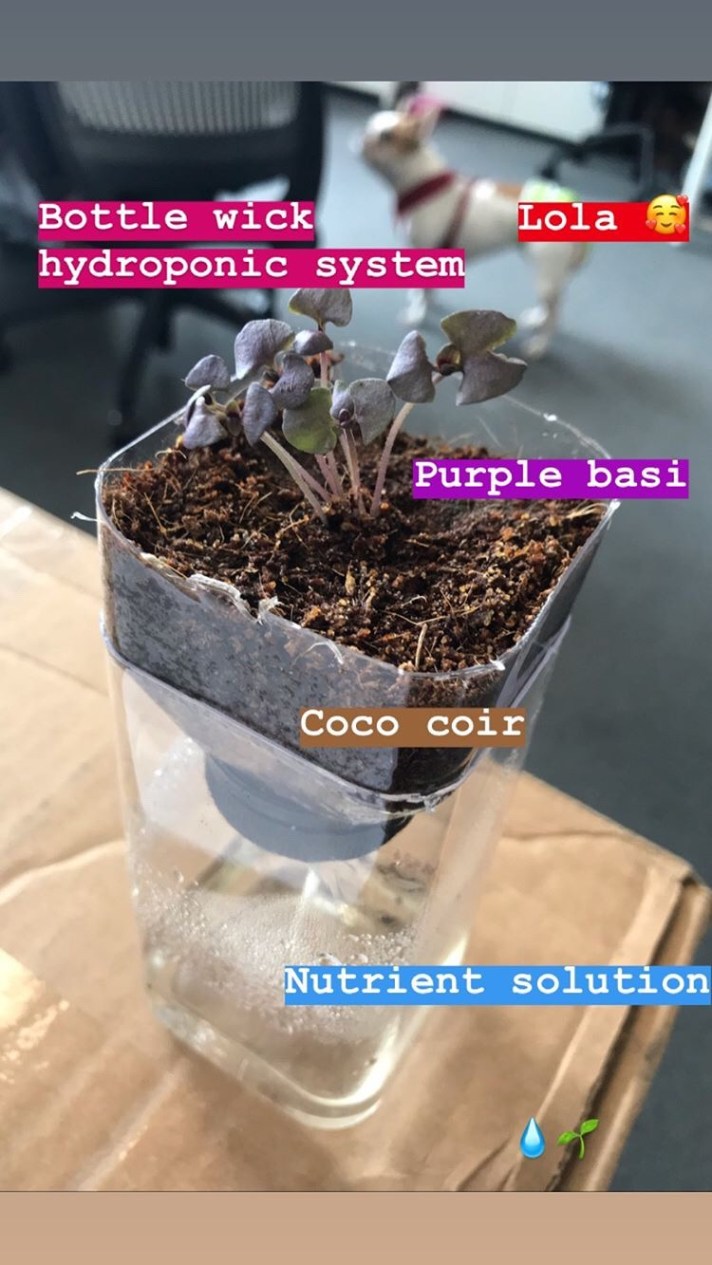
    Coco coir is made from the outside of a coconut husk and provides the seed with a moist home and later provides support for the plant’s roots. Flatten the coco coir by gently patting it down on the surface. If you use the plug version of coco coir (see link below), tear the plug on one side and sandwich the top end of the wick between the coir to ensure moisture is drawn up to your plant.
  7. Cover with plastic wrap and a rubber band and place near the light source until sprouting.
    This will increase the humidity in the top chamber and increase the rate of seed germination (sprouting).
  8. Remove the plastic when you see any sign of a sprout.
    Once you see any green sprouting out of the coco coir (or purple if you planted purple basil), be sure to remove the plastic to allow the plant to grow tall and reach its full potential.

Afinished Hydroponic Wick Bottle Systems made by middle schoolers in Brownsville, Brooklyn with Teens for Food Justice. @Hydroponics.NYC

*Be sure to add nutrient solution initially to the bottom chamber and refill with tap water as needed, since it will evaporate out and get used up by your plant.

adone.png Purple Basil.

IG accounts:
@Hydroponics.NYC
@Matthew_Gerard_

Build A Deep Water Culture (DWC) Hydroponic Garden in Less than an Hour — August 9, 2019

Build A Deep Water Culture (DWC) Hydroponic Garden in Less than an Hour

Ever have the urge to grow something green? Since most of us live in cities, access to space to grow plants is practically non-existent, and soils are often contaminated with heavy metals and other industrial pollutants. Despite these conditions, people are using creative hydroponic growing techniques that do not require soil or much space to grow nutrient-dense food in their homes.

Hydroponic systems are unique in that they do not use soil to grow plants. Instead, plants use nutrient-rich water (nutrient solution) and growing media (like coco coir, made from coconut husks) for nutrition & root support. 

Recently, I created a container deep water culture hydroponic system by re-purposing an old storage container (10 gallons). In deep water culture (DWC) systems, plants sit directly in nutrient-rich water, and an air pump & air stone keeps the water from getting stagnant by blowing bubbles into the water.

It was super easy, and I’ve outlined the steps here so you can construct your own DWC hydroponic herb garden for your home today!

Step 1: Gather your materials (see links at end of the post):

-10-gallon storage tote (or bus box with lid),
-Drill,
-2″ hole saw drill attachment,
-Net pots (2″),
-Coco coir plugs,
-Dry nutrients part A and B for lettuce (also good for herbs),
-Digital EC meter & pH meter,
-Measuring spoon (1 teaspoon),
-Air pump,
-Air stone,
-Herb & lettuce seeds

Step 2: Drill holes into the lid of your storage tote.

5-8 plant sites fit well per 10-gallon container, this spacing will allow your plants to grow to full maturity. Lettuce takes 4-6 weeks to harvest, and cooking greens & herbs take 8-12 weeks. 

unnamed @Hydroponics.NYC

Step 3: Fill the container nearly to the top with tap water & add dry nutrients.

A simple method for making nutrient solution is to take a quart-sized container and fill it nearly to the top with tap water (you can use the water that is already in your tote.) Then, mix a teaspoon of part A and a teaspoon of part B of the dry nutrients until all nutrients dissolve in the water. Add nutrient solution to your 10-gallon container and fill it with tap water until it is nearly full. Measure the electrical conductivity (EC) using the handheld digital reader.

You want the EC to measure 900-1300 ppm (1.5-2.5) to grow most herbs and lettuce, and you can add 1/4 of a teaspoon of each part A & B  and then measure the EC again, repeat as necessary until you reach the desired EC level. After each harvest, check your EC and add nutrients & water when necessary to maintain the 900-1300 ppm (1.5-2.5) range.

*For cucumbers/peppers/tomatoes, desired EC range: 1500-2500 ppm (2.5-3.5).

Step 4: Installing the air pump and air stone

The air pump attaches to the air stone via a small plastic tube (usually provided). Place the air stone in the nutrient solution and the air pump at a higher elevation than the level of the water in your deep water culture system (to prevent a siphoning of water out of your system).

IMG-8632 

IMG-8633

@matthew_gerard_

Step 5: Insert the net pots and coco coir cubes into the holes you cut for each plant site.

You want the bottom of the net pots to be submerged in the nutrient solution, then add a coco coir plug to each plant site.

Step 6: Plant your seeds & place them under a light source.
Now you are ready to plant your seeds in each plug (Ideally, 1 lettuce seed per site or 3 herb seeds per site)

*Be sure to place your system under sunlight or an artificial light source to ensure your plants can photosynthesize!

IMG-8627

@matthew_gerard_

Suggestions:
-If it’s summer, consider placing your DWC hydroponic garden outside under direct sunlight, or if one of your windows gets a ton of sun, place it there.

-If you have space under a coffee table, consider using this lamp or installing these lights on the bottom of the table and placing your DWC hydroponic garden under there.

Links to Materials I used:

IG accounts:
@Hydroponics.NYC
@Matthew_Gerard_

IMG-8634

NY Harbor, Jamaica Bay, and the Rockaways’ Fight Against Williams Natural Gas Pipeline — March 23, 2019

NY Harbor, Jamaica Bay, and the Rockaways’ Fight Against Williams Natural Gas Pipeline

A couple of weeks ago, I felt the need to stand up publicly and testify at the New York City Department of Environmental Protection’s (NYCDEP) public comment session on the proposed Northeast Supply Enhancement Project (NESE), also called Williams Pipeline for short, which would transport fracked natural gas via the construction of a 23 mile pipeline that “would run along the Staten Island coast and extend out to four miles off Rockaway” (Santino, 2019).

map.jpg *Note the existing pipeline was pushed through and built after Hurricane Sandy, when local residents were preoccupied with the rebuilding of their homes and communities (Source: NYC Surfrider Foundation).

The NYCDEC has to approve a crucial water quality permit before construction can begin. There is a federal law that requires an environmental impact statement (EIS), to look at the impacts to wildlife and human health before moving forward with projects like this. The first hearing was held on 02/26/2019, in Bay Ridge, Brooklyn, during rush hour, on a weekday, and in a hardly accessible area if you travel by public transportation from the areas that would primarily be impacted by the pipeline’s construction, such as the Rockaways. Not many from my area were able to attend.

FT.jpg Fort Tilden, NYC. @hydroponics.mh

After public pressure on the NYCDEC to have it in an area where potentially affected residents live, there was a second public comment session held just one mile from my home on the Rockaway Peninsula in the auditorium of Rockaway High School for Environmental Sustainability. I felt the irony of sitting in a school devoted to environmental sustainability, and at the same time protesting the approval of such an unconscionably unsustainable project.

I can trace my interest in environmental justice and sustainability back to my first interactions with the ocean and its wildlife as a young kid. My parents took us fishing on the beaches of the Breezy Point Tip, and I was always fascinated by the diversity of creatures I discovered near the sea. I feel blessed and grateful to have been raised so close to this amazing natural area, having found a place among the seagulls, horseshoe crabs, piping plovers, and other enchanting forms of wildlife early in my life. These places are a home to several endangered animals and plants, and are some of the last wild sanctuaries still found in NYC.

oc An oystercatcher in Rockaway Beach, NYC. @hydroponics.mh

Apart from my personal connection to the land and its people, I do, as a graduate from a master’s program in environmental management and sustainable development, understand the scientific review of the potential risks laid out in the draft environmental impact statement conducted by the NYCDEP. With this educational experience, and growing up in the local community, I felt uniquely obligated to testify at the public comment session on March, 6th, 2019. I will not go into the many risks associated with the project here, but will include some helpful resources at the end of this post if you are interested.

Riis Jacob Riis Park @hydroponics.mh

To be honest, there were challenging mental barriers that almost prevented me from testifying. I remember thinking many times, I could be at relaxing at home in my apartment and warm, not walking in the cold to the bus to attend this public comment session. When walking into that building after a long day of work and tired, I remember the thoughts of inadequacy and doubt flooding my thinking when I walked to into the auditorium. Am I really as qualified as I think I am to speak on this?

Yet, I continued to walk to that high school auditorium, to stand in front of a panel of NYCDEC representatives and over 100 of the residents of the Rockaways and other surrounding local communities. Did I mention how much I hate public speaking? I made it short and to the point, as it took over an hour and a half for them to call my name.

My comment addressed the concerns for human health and wildlife when the pipeline is constructed. There would be dredging of sands and sediments off the coast of the Rockaways and Staten Island that are holding and storing safely the industrial toxins of the last century. This action would release toxins like PBCs, heavy medals, and other industrial pollutants into the water column where organisms live and where people swim. The result would be poisoning of people and wildlife that interact with the waters off the Rockaways/Jamaica Bay.

nana “Exploring with my Nana at Jamaica Bay Wildlife Refuge, NYC, on 12/30/13.” @hydroponics.mh
I tell this story not to show off how great of a citizen and environmental advocate I am trying to be, but to point out that we need to persist over the many barriers (mentally and physically) that keep us from speaking out when we know we are qualified and worthy of doing so effectively.

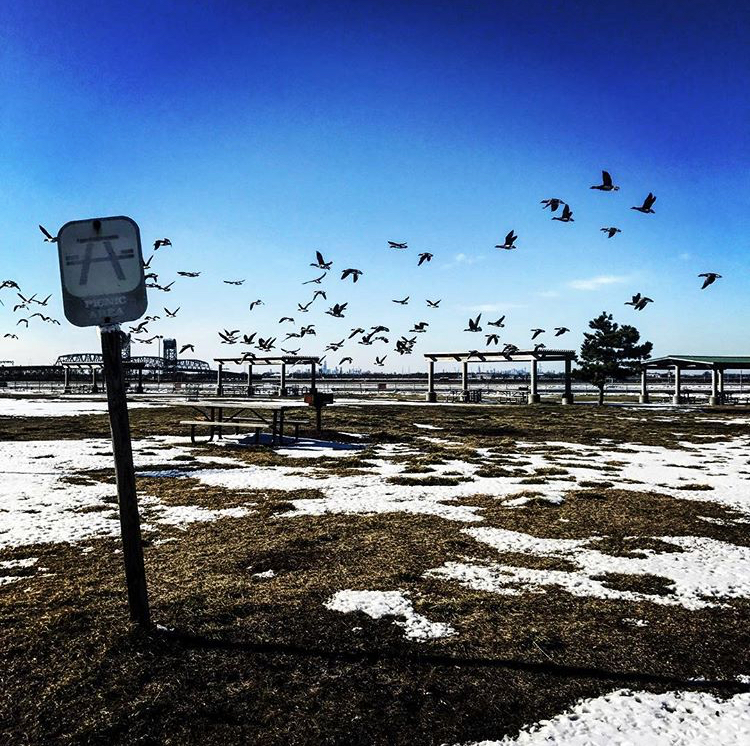
geese.jpg Jacob Riis Park. @hydroponics.mh

Although the comment period has ended, you can still act to oppose the NESE project (see below:)

“Those interested in helping this cause can visit stopthewilliamspipeline.org, call Cuomo at 877- 235-6537 or text ‘RENEWABLES’ to 69866” (Santino, 2019).

Watch this short clip to learn more about the proposed pipeline:
The Fight Against The Williams Pipeline:

Local News Article:
The Push To Stop The Williams Pipeline:

The Push To Stop The Williams Pipeline

Here is a link to an amazing (and my favorite) documentary about how NY Harbor and Jamaica Bay is experiencing positive ecological renewal as a result of the past 20 years of cleaning up the bay and environmental awareness generated through local advocacy, as well as explores the impacts of Hurricane Sandy on a local NYC community, Broad Channel (This natural and inhabited area would all be affected by the proposed pipeline):

Saving Jamaica Bay:

“Life is a garden, not a road. We enter and exit through the same gate. Wandering, where we go matters less than what we notice.” — Kurt Vonnegut

IG accounts:
@Hydroponics.NYC
@Matthew_Gerard_