Sustain Everyone

@SustainEveryone

Archive: French Hospitality — September 14, 2015

Archive: French Hospitality

People often come together for a meal for various occasions. Moreover, food is often the perfect way to experience a new culture. Shortly after moving to France, I met someone I now call my boyfriend. This is totally new to me, but I am learning so much from Matthieu. I was extremely grateful to be invited to his sister’s surprise birthday a couple of weeks ago on his aunt and uncle’s farm. The farm is situated about 40 minutes outside the city of Angers, in Cheffes, France. They raise cattle for dairy and meat, corn, rabbits, and chickens (among other things).  Despite my fascination with the agriculture, I was captivated by his family’s welcoming nature towards someone who can barely speak a full sentence of their language.

When we arrived at the farm, about 30 of his family members and friends greeted us. To say I was intimidated is an understatement. I was nervous, not only to meet my boyfriend’s entire family, but also I was afraid to interact with people who speak a completely different language than me. I wondered if I would unintentionally offend someone, yet this was not the case at all. Since I had already met Matthieu’s parents the previous week, his mother was quick to introduce me to her siblings, cousins, and countless other family members and friends. Although we could not say more than a few words to each other, they seemed to be happy to meet me. I felt a sense of belonging and was honored that they let me be a part of this special occasion.

At the beginning of the party (around 9pm), we drank some red wine, which was followed by some champagne. Matthieu’s sister, Margaux, was extremely surprised and pleased to see all of her family and some of her close friends at her aunt and uncle’s house to celebrate her 18th birthday. Matthieu and Margaux are about a year apart in age, and their relationship reminded me so much of my relationship with my sister Alexa. Being so far away from home and watching them interact made me miss Alexa greatly. I was still so happy to be in the presence of a wonderful family celebrating such a joyous occasion, even though I missed my own family.

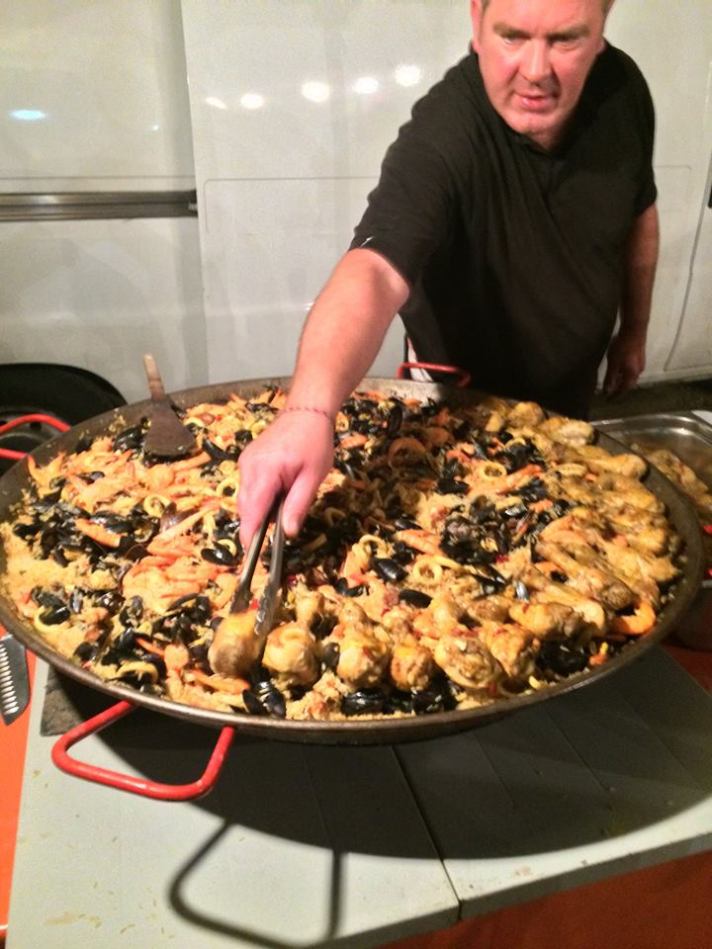
As the night progressed, we sat down for a fantastic home cooked meal: paella (see picture above). I have not eaten a better meal in France till this day. Followed by a birthday cake and other delicious desserts, we drank a tasty, strong after dinner pear liquor called “Liqueur de poire.” There was loud music and a place for people to dance. Nearly everyone sang and danced until the early hours of the morning. If I learned one thing that night, it was that the French know how to eat and drink (and party). Matthieu’s family was warm and friendly towards me and made me feel like I was part of their family. Above all, they seemed to genuinely enjoy each other’s company, which was refreshing to see.

The next day we awoke around noon. I immediately went to explore the farm in the daylight with Matthieu. I saw the rows of corn, the cattle roaming in their paddocks, the rabbits eating in their cages, and the chickens. It might sound mundane to some (Matthieu grew up around all of this so it was nothing new to him), but I was in awe at the diversity on the farm. There were pear trees and a home vegetable garden as well as two baby calves that were born two days earlier. They were, by far, the cutest animals on the farm. I had Matthieu to help me talk to his aunt about the farm. He translated for me as I asked some basic questions about their home. They raise the cows primarily for milk production, so generally they do not keep the male calves (which meant one of the two baby cows I saw were going to be turned into veal). I did not get a chance to ask them about their specific farming techniques, as Matthieu was exhausted from having to be my translator the night before. Their farm, however, was breathtakingly beautiful and full of life. I felt at peace there and not at all out of place. I am thankful to have had this experience with Matthieu and his family.

Another thing I learned on this trip to the countryside was that the French do not like to say quick goodbyes. After exploring the farm in the daylight, whoever remained from the party sat down to eat a late lunch and to continue celebrations for Margaux’s birthday. We ended up staying until the about 6pm, after many of Matthieu’s family members helped with the cleanup from the party the previous night. Once the house was back in order, we said goodbye to his family in the traditional French way of two (or sometimes four) kisses on each cheek. It may have seemed like a long goodbye, but when I think back on it I believe the reason it was not a quick goodbye was because no one wanted to leave. Their family is very close and they did not want to say goodbye or leave without helping clean up. I felt this was truly thoughtful of them and so adorable.

I do not normally write blog posts that are this personal, but I am glad to be able to share my wonderful experience with others. With an approaching research internship that I must complete next semester (which could take place anywhere in the world), the future of me and Matthieu’s relationship is far from certain, yet I am still so happy to have met such an incredible and thoughtful human being. I am trying to live in the present moment and enjoy our time together without letting the future ruin today. We can never know what could happen in the future 🙂

“Tomorrow is tomorrow.
Future cares have future cures,
And we must mind today.”

– Sophocles

Archive: The Value in One’s Sense of Place on Earth — July 5, 2015

Archive: The Value in One’s Sense of Place on Earth

More than ever before in my life, I see the tremendous value in having a sense of place or a connection to where I live my life. I view this feeling of community and interconnectedness as essential for a person’s wellbeing, yet it seems people today have given up on this idea to an extent. We travel to exotic places for vacations to escape the daily life we created for ourselves, move away for a school or job position, and dream of picking up everything and moving to a new location for any reason. Not everyone has lost their sense of place, but the majority of us now living in cities know very little about the places where they live and have very little attachment to their current places. This has detrimental consequences for the sustainability of any culture or community.

When I moved to Austin, Texas last August for graduate school, I barely gave it a second thought. I was able to move to a state far from home for my first year to study at St. Edward’s University and discover what I wanted from life. It was an obvious choice to go for me. After completing my first year, the program requires a semester abroad in Angers, France, so I will be moving to Angers at the end of the month. Before my studies began here in Austin, I was again away from where I grew up to earn my undergraduate degree in Environmental Studies in Binghamton, New York. Although it was only a three and a half hour drive from home, it was far enough to feel as though I was in a new place. I was truly in a new place. All of the moving around has taken its toll on me though. Don’t get me wrong, I have had some experiences that I would not trade for the world, and I do not regret my decisions. There is, however, something missing, and I believe it has to do with the sense of community (which starts with our connection to place).

Now, why is our sense of place and connection to the land so important? There are many environmental reasons to value the answers to this question, but I like to boil it down to one thing: sustainability. Not just the sustainability of the environment, but also of society as a whole. The natural environment is what we all depend upon on some level, but we also depend on our location to make sense of the social interactions we have among one another. More specifically, our knowledge of where we live, to a large extent, dictates how we think, act, and respond to life’s various and complex situations.

Since the majority of humans live in cities today, we have lost almost all connections to the natural environment. What we accept as “nature” in the city is disappointing and embarrassing. We value development over conservation. Essentially, we value more and not better (as Bill McKibben writes in Deep Economy). The natural world is in trouble, and very few of us are ready to accept that as fact. We eat foods that travel thousands of miles before it reaches our refrigerators and know nothing of the flora and fauna of the places we call home. We do not know how to grow our own food, nor do we know much about the food we buy from the supermarket. We have outsourced many of these things to a few specialists, and this will one day be a major problem. Change is the law of life. If we rely on others for something as basic as food (and water), then we are at the mercy of those in that position of power for our most basic human needs. Ignorance is not bliss.

Beyond the sustainability of the food system and the natural world, we are at risk of losing all connection to one another. The anonymity and individualism that is provided to us by cities can be beneficial in many ways, but taken to an extreme (as we have done today) we can easily destroy our sense of community. This may seem to some as not such a huge deal, but it is for stability of our communities. Humans need to feel like they belong, but we allow ourselves to become so disconnected from one another, as we connect to our WiFi. Technology has made it way easier to facilitate this shift. Many people today do not even know their neighbors and this disconnection from humanity causes unnecessary violent crimes to take place every day. To give you an idea of how big our social problems are, consider this statistic: one in five woman are victims of sexual assault on college campuses today. Violence is pervasive in our culture today; This is how we treat the members of our community. We stay out of other peoples’ business, and sometimes we even ignore the turmoil of those in our own family. This does not come as a shock to me because we live in a world where it is so easy to escape from the reality of our circumstances.

It is not just crime that rises when we lose our sense of community, but also our health more broadly. Obesity is at an all-time high in the United States because we have lost our connection to our place and time. This is a preventable disease of modern society, yet we continue to allow soda companies to fund our sporting activities. The advertising is all over the place for these products, and the main ingredient (sugar) is the leading cause for obesity. If we truly were committed to ending the obesity epidemic, we would rid our communities of these drinks and of the fast food establishments on every other street corner. Similarly, our “War on Drugs” has taken a huge toll on the mentally ill all around the world, which criminalizes and locks up those who would instead benefit greatly from medical treatment. Viewing things like obesity and addiction as personal choices or struggles is only half of the picture. What we choose to value and how we act towards these things defines who we are as a people. I for one do not want to be defined by absentee legislators who have the power to decide what is best for your community. Every place is different, and each place requires a unique stewardship that should be defined by local residents.

With all of this in mind, I am ready to move somewhere and stay there. After I finish Master’s degree in Environmental Management and Sustainability, I am committed to living in a place. I want to build a sense of community and be a steward of the land I live upon. I want to live in a place where I do not feel the need to run away on an expensive vacation to feel peace and serenity. I want to live in a community where we look after one another, as opposed to a place where neighbors compare themselves to one another and fight with each other. We could all afford to turn off our electronic devices and go out into the local community where we live to see what and who needs our help. Everyone has something unique to offer, but we have to find the courage to recognize and believe in our strengths to make a difference in this world.

Archive: Why Community Gardening? — May 11, 2015

Archive: Why Community Gardening?

Today, as I look back on my first year in the MSEM program at St. Edward’s University, there is one question my research partner and I kept receiving the most: “Why are you researching community gardens?” For us, the answer seemed obvious from an environmental perspective, but we soon realized this shared understanding we had for food’s role in environmental degradation was the product of taking many classes in our undergraduate education that related specifically to these types of issues. Given that our current degree program required us to design, conduct, and present our own research project, my partner and I sought out to reveal how much these community gardens are capable of producing on the amount of land they have.

Moreover, the issue of food insecurity, which exists when low income households does not have access to sufficient, safe, nutritious food to maintain a healthy and active life year round, is not a topic you will frequently hear being discussed on the daily local or even the national news programs on television in the United States. The severity of this problem, however, cannot be underestimated by those in power today. At the conference on Trade and Development in December of 2013, the United Nations produced a report calling for a 70 percent increase of food production by 2050, as counted by calories, if we are to sufficiently feed the projected human population of about 9 billion people. The advisors to this report urged that we achieve food security by changing the way we produce and consume our food (Trade and Environmental Review, 2013).

With this information about the state our current food system, the project my research partner and I came up with aimed at quantifying the potential yield of community gardens throughout the city of Austin, Texas. Community gardens were a starting point we thought we could use to get a glimpse into what urban agriculture was producing in Austin. The potential yield of a garden is simply the theoretical amount of food the garden is able to produce in a given period of time. We used actual yield data from one of these gardens to make our estimations for the potential yield of the 18 public certified community gardens we studied in Austin.

Furthermore, to accomplish the task of estimating the potential yield for our research project, we had to visit each site to collect the dimensions of each individual plot at the 18 study sites. Having this information, and the total area of the gardens, we were able to calculate a percent utilization measure for each garden. This value allowed us to see how much (in a percentage) of the total land they were actually using to produce food and was used to compare with the actual yield data we obtained from one of our study sites. This actual yield data, though only for one crop type, spanned over four years. We took the percent utilized by each garden to get a more precise measure of their potential agricultural yield. We also used ArcGIS software to create maps overlaying food insecurity with existing sites of urban agriculture in our final research paper. Then we added a layer of “prime farmland” to the map, as well as points that were identified by the city as “eligible” for urban agriculture, which gave us the ability to make recommendations as to where the ideal sites for future development of community gardens are located. Based off of our maps, we identified two primary areas of focus for the city of Austin, Texas. (Feel free to contact me if you are interested more in our methods!)

Ultimately, we presented our findings at St. Edward’s University’s 3rd annual Graduate Research Symposium for the MSEM program, and they were well received by our professor and a few people from the city of Austin who we worked closely with throughout the project. There were some truly amazing people we met along the way, including city officials interested in our data for funding and support, gardeners willing to answer any question we could think of, and volunteers working with the soil. We worked closely with three people from Austin: one individual works at a non-profit organization called the Sustainable Food Center, the second individual works for the City of Austin’s Parks and Recreation Department, and the third works for the City of Austin’s Office of Sustainability. As we were thankful for their ample assistance throughout the course of our project, they were all very grateful to get some field data about the 18 public community gardens we visited and for the maps identifying ideal site locations for future development of community gardens.

Although I am extremely happy with the way our project turned out, I am admittedly not done exploring and discussing the possibilities food will bring us in the future in terms of sustainable development of the environment and of society at large. We have the opportunity to increase local food production, which could have various side effects for the good of humanity. One aspect of community gardening easily overlooked is the amount they contribute to social capital of a community. There were certain gardens we visited where there was clearly designated space for community gatherings and celebrations. These places seemed to be more than just places of food production. Some of the gardens had educational programs, spaces for social gatherings, opportunities for community service, and more. If we had more time, Tessa and I would have loved to study the social impact, as well as the environmental impact of these gardens on a community.